
6 Content Optimization Services Worth Paying For in 2026
So you've published content you're proud of—well-researched, clearly written, genuinely helpful. But it's sitting on page three while thinner, less useful pages rank above it. It isn’t you or your brand. It’s just that the gap between good content and visible content isn't just quality (though that matters. A lot). It's optimization.
Content optimization services ultimately take what you've already created and make it discoverable. They refine keywords, improve structure, and align how search engines, AI tools, and humans all evaluate pages. Let’s talk about the top six services that actually move the needle for revenue. We’ll cover why they’re worth the investment, how to evaluate service providers, and what the process looks like.
Why Great Content Still Fails to Rank
Here's what's happening when your content isn’t ranking: search engines don't read content the way people do. They're scanning forspecific signals—keyword placement, structure, internal links, freshness, technical markup—that tell them a page deserves visibility.
Great writing without those signals is like a fantastic restaurant with no sign out front. People can't find what they don't know exists.
Content optimization bridges that gap. It takes what you've already created and makes it discoverable.
For organizations in technical or regulated industries, accuracy matters as much as visibility. This work often requires more than a quick DIY pass with a keyword tool. It requires skilled service providers who can take your expertise and reform it into something both humans and search engines will value. That’s a delicate balance, to be honest. You can run your work through all the AI content generation tools you want, and you’ll still struggle to find that balance without experts on your side.
What Leading Content Optimization Services for SEO Often Include
Put simply, content optimization services improve existing pages so they perform better in search engines and AI answer engines. The goal isn't to create new content from scratch. The goal i's to make what you already have work harder to earn your business money.
Most providers offer some combination of the following:
Keyword strategy: Refining target terms based on current search data and user intent
Readability improvements: Restructuring paragraphs, headers, and flow for easier scanning
Technical SEO: Updating meta tags, headers, schema markup, and internal links
Content freshness updates: Replacing outdated statistics, examples, and references
AI search optimization: Structuring content so AI tools like ChatGPT and Google's AI Overviews can cite it
Conversion rate optimization: Structuring the copy, blog template layouts and CTAs to turn your blog from a skimmable article to a revenue-generator
Specifics (and quality) vary by provider, but the underlying principle stays the same: optimization makes content more visible and more valuable without starting over.
6 Content Optimization Services Worth Paying For
1. SEO Content Optimization
This is the foundational service—the one most people picture when they hear "content optimization." SEO content optimization focuses on improving individual pages so they rank higher in traditional search results.
The work typically involves refining keyword targeting, strengthening internal links, and adding depth where the content falls short. A thin 500-word post might become a comprehensive 1,500-word resource. A page targeting the wrong keyword might get repositioned entirely.
If you're only going to invest in one type of optimization, this is usually the starting point. When evaluating leading content optimization services for SEO, this is where to start.
2. GEO and AI Content Optimization
GEO stands for Generative Engine Optimization. It's a newer discipline focused on getting your content cited by AI answer engines—tools like ChatGPT, Perplexity, and Google's AI Overviews.
When someone asks an AI a question, where does the answer come from? Increasingly, it comes from content that's been structured to be AI-friendly: clear definitions, direct answers, well-organized sections. GEO optimization positions your content to be that source—and brands cited in AI Overviews earn35% more organic clicks.
With traditional search engine volumedropping by 25% as users shift to AI tools, this service is becoming harder to ignore.
3. Website and On-Page Content Optimization
Your homepage, service pages, and product pages carry more weight than blog posts. They're where conversions happen—where visitors decide whether to reach out, sign up, or move on.
Website content optimization focuses on high-stakes pages, improving both search visibility and the ability to turn visitors into leads. This work often overlaps with UX writing. It's not just about keywords; it's about clarity, flow, and persuasion working together.
4. Blog Content Refresh and Optimization
Content decay is so very real. A blog post that ranked well two years ago might be slipping now. The information may be outdated, competitors may have published better resources, or search intent may have shifted.
Blog refresh services identify underperforming posts and bring them back to life. Sometimes that means updating statistics. Sometimes it means rewriting entire sections or consolidating multiple weak posts into one strong one.
The goal is to recapture rankings you've lost—or finally earn rankings you never had.
5. Conversion-Focused UX Content Optimization
Not all optimization is about rankings. Some of it is about what happens after someone lands on your page.
Conversion-focused optimization improves microcopy (buttons, error messages, form labels), CTAs, and page flow to increase the percentage of visitors who take action. This service bridges SEO and UX writing. It's particularly valuable for pages that get traffic but don't convert. That’s a really frustrating problem that pure SEO work won't solve.
6. Compliance-Aware Content Optimization for Regulated Industries
Organizations in regulated industries (healthcare, finance, legal, etc) can't optimize content the same way a lifestyle blog can. Claims have to be accurate. Disclaimers have to be present. Regulatory requirements have to be met.
Generic optimization services, where you have junior and mid-senior writers from varying copy backgrounds doing the work, often miss these nuances. You might get optimized content that ranks, but it exposes the organization to risk. Compliance-aware optimization by advanced researchers and writers balances performance with protection, making sure content can withstand scrutiny from both search engines and regulators.
For organizations where accuracy isn't optional, this specialized service is definitely worth the investment.
How to Choose the Right Content Optimization Service
So how do you know what fits your situation? The answer depends on your industry, your goals, and the complexity of your content. But a few criteria apply across the board.
Subject-Matter Expertise and Author Credibility
Google's E-E-A-T framework (Experience, Expertise, Authoritativeness, Trustworthiness) rewards content created by people who actually know what they're talking about. For YMYL topics (Your Money or Your Life) this matters even more.
Ask whether the provider has real expertise in your industry. A generalist agency might be fine for a lifestyle brand, but technical or regulated content often requires trained specialists who understand the subject matter deeply.
Technical SEO and AI Search Capabilities
Content optimization withouttechnical SEO support is incomplete. If your site has crawlability issues, broken schema, or slow page speed, even perfectly optimized content won't perform the way it could.
Look for providers who understand both the content and technical sides—and who can optimize for AI search, not just traditional search.
Evidence-Based Content and Original Research
The best optimization adds value, not just keywords. Content that cites original data, includes expert perspectives, or offers genuine insight tends to outperform content that simply matches competitor word counts.
Ask how the provider approaches research. Can they enhance your content's authority, or are they just adjusting keyword density?
Compliance and Regulatory Awareness
If you're in a regulated industry, this isn't optional. Ask whether the provider understands your legal constraints and has experience working within them.
Optimization that creates compliance risk isn't worth the rankings.
Measurable Outcomes Beyond Rankings
Rankings are nice, but they're not the end goal. Traffic that doesn't convert is just a vanity metric.
Look for providers who track conversions, traffic value, and business impact—not just position changes in search results.
How Content Optimization Works
Wondering what an engagement actually looks like? Here's a typical workflow, step by step.
Step 1. Content Audit and Performance Diagnosis
Optimization starts with understanding what you have. A content audit identifies underperforming pages, content gaps, and quick wins—pages that could rank with relatively minor improvements.
Step 2. Keyword and AI Query Mapping
Next, the provider maps your existing content to search queries and AI prompts. This reveals optimization opportunities: pages targeting the wrong keywords, pages missing obvious terms, or pages that could be consolidated into stronger resources.
Step 3. Rewriting and Re-Optimizing Existing Pages
This is where the actual optimization happens. Sections get rewritten, structure gets improved, depth gets added, and readability gets enhanced. The goal is content that's genuinely better—not just more keyword-dense.
Step 4. Technical and On-Page SEO Fixes
Supporting technical work happens alongside content changes: meta tag updates, header restructuring, internal linking improvements, and schema implementation.
Step 5. Re-Publishing, Monitoring, and Iteration
After optimization, the work isn't done. Performance gets tracked, your content distribution strategy gets refined, and the cycle continues. Good optimization is iterative, not one-and-done.
Hiring a Service vs. Using a Tool vs. Doing It In-House
You've got options. Here's how they compare:
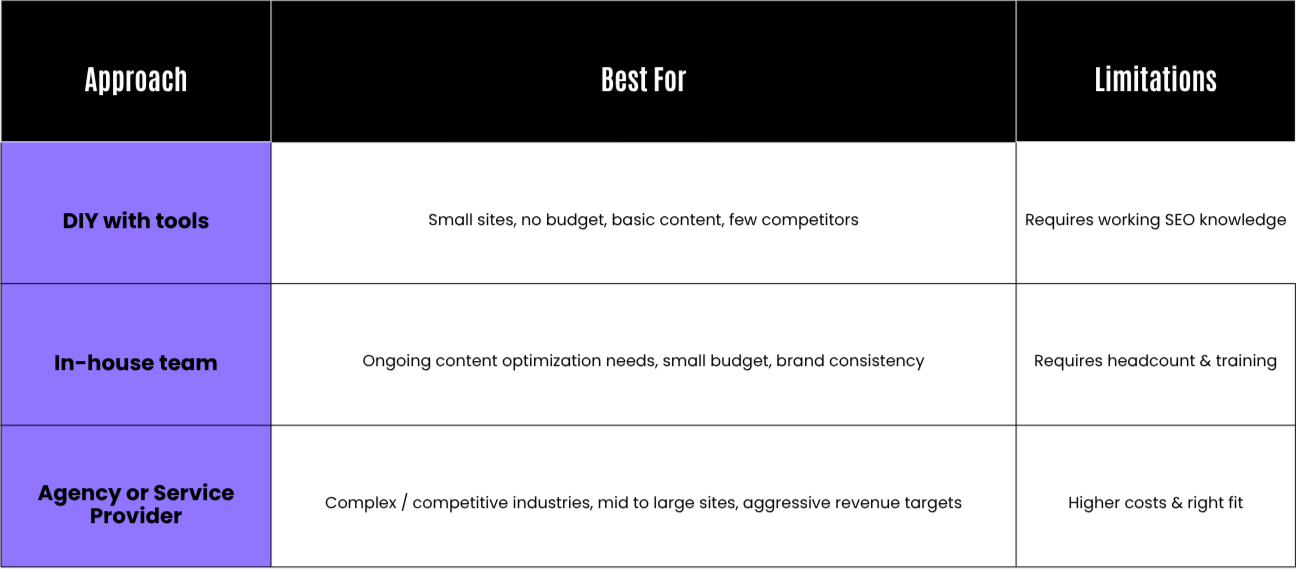
Tools like Clearscope, Frase, and Surfer SEO can help with keyword suggestions and content scoring. But they don't replace strategic thinking, and they definitely don't understand regulatory requirements or industry nuance.
For organizations in technical or regulated spaces, expert services provide value that tools can't match.
Frequently Asked Questions About Content Optimization Services
How much do content optimization services cost?
Pricing varies widely. Basic optimization might run a few hundred dollars per page, while comprehensive services for compliance-heavy or highly technical content can cost significantly more. The right question isn't "how much?" but "what's the return?"
How long does it take to see results from content optimization?
Most optimized content shows measurable ranking improvements within a few weeks to a few months. Competitive keywords and newer domains typically take longer. Patience matters here—optimization is a long game.
What is the difference between content optimization and content creation?
Content creation produces new material from scratch. Content optimization improves existing content to perform better. They're complementary, not interchangeable—and a strong content marketing approach benefits from both.
Can content optimization help pages appear in AI search results?
Yes. GEO (Generative Engine Optimization) specifically structures content to be cited by AI answer engines. As AI search grows (with AI Overviews reducing organic clicks by 58% for top-ranking pages) this capability is becoming increasingly important for visibility.
Get Started With Content Optimization Services for SEO
Content optimization is both art and science. It requires strategic thinking, technical expertise, the ability to connect with and persuade real humans, and often specialized industry knowledge.
For organizations in complex or regulated industries, working with leading content optimization services for SEO makes a massive difference. It ensures content ranks and withstands scrutiny.
If you're ready to turn underperforming content into a growth engine, let’s talk.
